If the Pearl Had Kept Growing
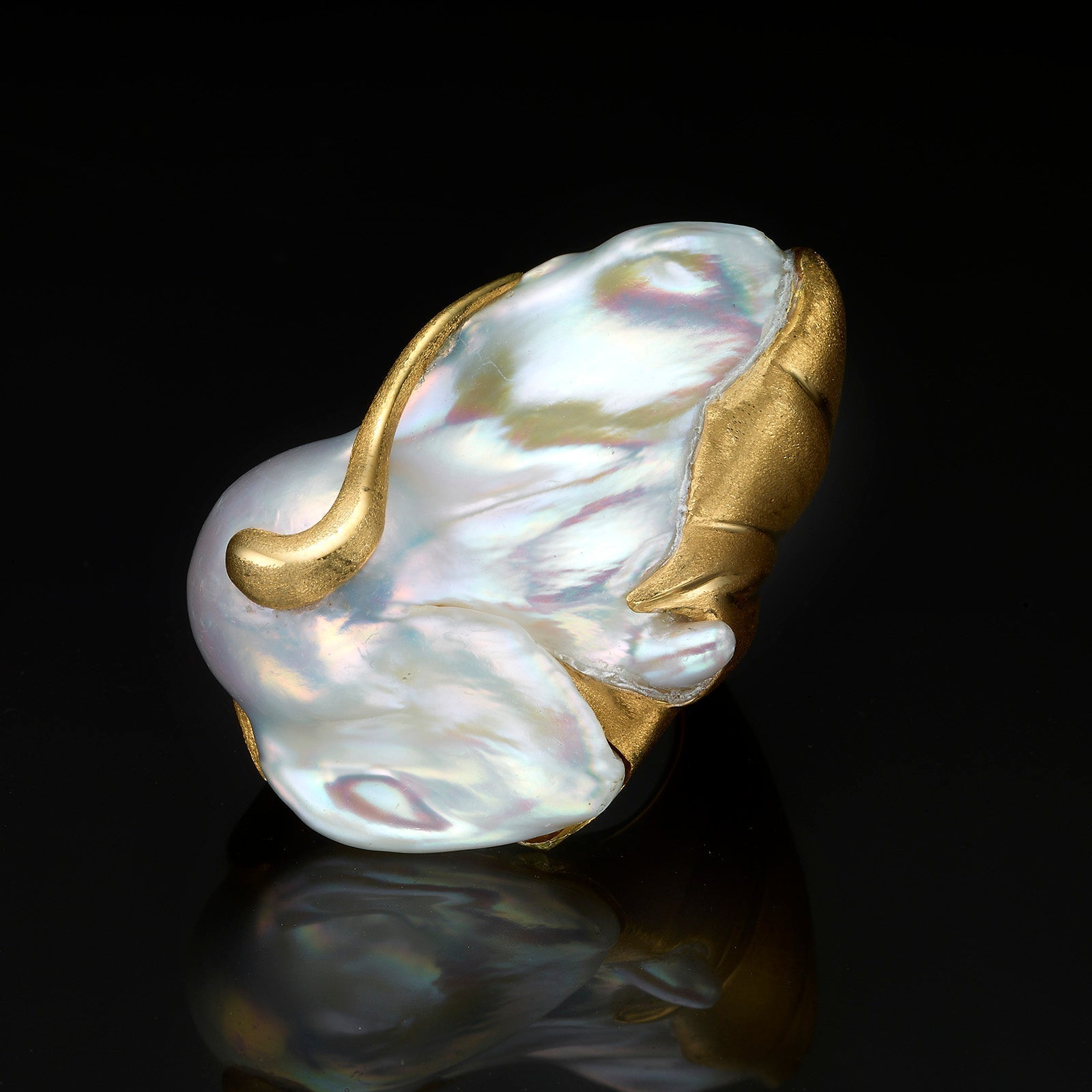
Most jewelers make a piece and then find a stone to fit it. I work the other way around. I start with the pearl, and I ask what it would have become if it had stayed in the shell a few more years.
That question is the whole design. The gold is my answer to it.

The black mark on that pearl is where the gold will run. That is the first decision, and everything else follows from it.
How I learned this
I had done a basic goldsmithing course, and when it ended I got on a plane east. But wax was something else, and for that I wanted a proper course. Lital, before we were married, wanted to make that happen for me. Then she saw what it cost, and the idea quietly died.
I am grateful for that now. In this trade nobody hands over what they know, so I came home from work each evening to a studio that held one basic bench, and I started experimenting. I filed wax, cut it, sawed it, heated it, and watched what it did.
What I worked out is that most people take a block and carve away from it. I found it easier to build up in layers, heating wax and bonding it piece by piece, then carving into what I had built. Years later I learned that this is not how it is usually done. I still carve from a solid block when the form calls for it, the dragon bracelet's head among others, but the layered method is mine.
Why wax and not gold
Wax gives me room to change my mind. I can add, remove, warm a line and move it, and the design stays open until I decide it is finished. Gold does not forgive like that.

There is also waste. Reaching a complex organic shape directly in gold means cutting away a great deal of metal. In wax that same shape costs almost nothing and the work is a pleasure. I do build directly in gold when a piece is geometric, mostly rings, where the form is defined by straight lines and clean curves rather than growth.
The waxes themselves
Wax comes in different colours, and each one has its own hardness and flexibility. I keep every type I could find, from the years when I was learning what each one does.

Blue is what I use most for pearls. It holds to the surface of a pearl properly, wrapping it rather than sitting on it. Green is for gemstones. A stone stays colder than a pearl, so the wax tends to separate from it, and green handles that better.
Pink is a different animal. It is soft enough that the heat of your fingers is the tool. No files, no burrs, just hands. That is what I reach for when I am shaping leaves or anything that needs to look grown rather than cut.
Heat is also the risk. A pearl tolerates it. Some gemstones do not, and a brittle stone can crack. Emerald above all.
0.6 millimetres

The thickness of the wax decides the thickness of the gold, and that is the part experience actually buys you. I judge it by holding the wax against the light and reading the colour and translucency. That tells me how much is there.
Six tenths of a millimetre is the floor. Below that the gold will not fill the cavity, and you get holes, or the cast fails outright.

It has to be thin, because weight matters. A ring you wear every day and a pair of earrings you wear all evening cannot be solid metal. So a complex form gets hollowed out from the inside, patiently, until what remains is a shell of gold six tenths of a millimetre thick across its whole length.
Diamonds pull the other way. To set stones there must be enough material for the setter to work into, especially with pavé, or the surface collapses under him. So even when I decide only after casting exactly where the stones will sit, and sometimes I do, because the diamonds are there to emphasise a line I only see once the piece is in gold, the thickness has to be planned from the beginning.
I wrote about that in detail elsewhere, on a brooch where the diamonds took four days to set.
What happens to the wax
The finished wax goes to the casting house, where it is joined with other waxes onto a single stem until the whole thing looks like a tree.
The tree is placed inside a metal cylinder with a rubber base and the cylinder is filled with a special plaster. It goes into a vacuum chamber that draws out every air bubble, so the plaster closes around the wax completely, and then it is left to set.
Once the plaster is hard the rubber base comes off and the cylinder goes into a kiln. The wax melts and runs out. What is left is a block of plaster with a hollow inside it in the exact shape of everything that was on that tree.
Then molten gold, 18K yellow for example, is forced into that hollow, either by centrifuge or under vacuum, which is the better of the two. The cylinder goes into water, the shock breaks the plaster apart, and a tree of gold comes out. It is steam cleaned and the pieces are cut from the stem.

From there the piece comes to my bench. First into a tumbler filled with tiny stainless steel pins in a bath, turned by a magnet underneath. A million small hammers reaching into every corner, clearing the last of the plaster and hardening the surface. Then the real finishing begins, and the pearl is fitted to the gold that was built for it.
When it fails
Early on I lost pieces that had taken days. The wax was too thin somewhere, the cast collapsed, and there is no recovering that. You cannot rebuild the same wax twice. Something in it was decided by hand in a moment you will not repeat.
That is the argument for experience, and it is the only argument. Hours for something small and simple. Weeks for a brooch like White Thunder.
Where you can see it

Every photograph above is the same ring, from the mark on the pearl to the finished piece. It is the Wave ring, and it is the second one. The first sold, and I made another. Not the same ring, because the pearl was a different pearl, and the gold had to answer a different shape. That is not a limitation of the method. That is the method.
Trip of Color is the same thinking with gemstones instead of a pearl.
Look at where the gold meets the stone on either one. There is no joint there, no moment where one material was fitted to the other.
This is not a new idea for me. A Swedish magazine interviewed me years ago, and what came back in print was that I think about the pearl inside the shell and how it changes over time. It is still the first thing I do with a pearl.
If you want something made this way, start here.
