
A Goldsmith's Guide to Pearls
A pearl is made by a living animal, so how it looks, how long it lasts and what it should cost all follow from how that animal made it.
How a pearl is made
Every pearl starts inside a mollusk, which builds it from layers of nacre, the same material that lines the inside of its shell. Nacre is what gives a pearl its glow, and the thickness of that coating decides how bright the pearl is and how well it holds up on the body.
A natural pearl forms by chance, around a microscopic irritant that gets into the soft tissue of the animal. The popular picture of a grain of sand is mostly a myth, because a mollusk usually pushes sand out again. Natural pearls are extremely rare: a commonly quoted estimate is about one in ten thousand oysters, at best.
A cultured pearl is the same thing with a human hand at the start. A technician places a small piece of living mantle tissue into the mollusk, sometimes together with a bead made of shell. The tissue forms a sac and deposits nacre, and the mollusk is tended for years until harvest. Without a bead, the nacre grows around the tissue alone, which is how most freshwater pearls are made today. All the pearls I use are cultured, from both seawater and freshwater shells.
Culturing round pearls was worked out in Japan in the early 1900s. Tatsuhei Mise and Tokichi Nishikawa each developed an implant method, and Kokichi Mikimoto patented his own process in 1908 and adopted theirs in 1916. By the 1920s cultured pearls were reaching the market, and the old natural pearl fisheries of the Persian Gulf, Ceylon and elsewhere declined over the decades that followed. That is why nearly every pearl you can buy today is cultured, and why that is not a mark against it.
The main kinds of pearl
Pearls come in a handful of families, and you will meet all of them in the trade. Most of the pearls in my own pieces are freshwater, keshi and baroque. The size ranges below are typical, not limits, and every family has exceptions.
| Pearl | Where it grows | Typical size | What it looks like |
|---|---|---|---|
| Akoya | Japan and China, in the Akoya oyster | about 6 to 9 mm | White to cream with rose or silver overtones, a sharp, bright lustre |
| South Sea | Australia, Indonesia and the Philippines, in the large Pinctada maxima oyster | about 10 to 16 mm and up | White and silver to deep gold. Long growing time gives thick nacre |
| Tahitian | French Polynesia, in the black-lipped Pinctada margaritifera oyster | about 8 to 14 mm | Grey, dark and brown bodycolors, often with green, purple or aubergine overtones |
| Freshwater | Lakes and ponds, with China the leading source | about 4 to 14 mm | Every colour from white to peach, lavender and gold. Many pearls grow in one mussel, which keeps prices lower |
| Cortez | Gulf of California, in the Pteria sterna oyster | about 8 to 12 mm | Black and very iridescent, with red overtones and a silky lustre |
Two details are worth knowing. Tahitian pearls are called black pearls, but truly black ones are rare, and most of the beauty is in the overtones. Cortez pearls have a long history, since black pearls from this region were known before Columbus and prized in Europe after the Spanish conquest. Pearl diving in the Gulf of California was banned in 1940 after overfishing and disease, and today only a small farm grows them, so they are scarce.
Freshwater pearls deserve a word, because they are often treated as the lesser cousin of seawater pearls. Most of them are grown from tissue alone, with no bead inside, so they are nearly solid nacre. The main mussel today is Hyriopsis cumingii, which farmers moved to in the 1980s after the older rice-shaped pearls of the 1970s, and a cross between that species and the Japanese Lake Biwa mussel is now widely used too.


Keshi and baroque pearls
A baroque pearl is any pearl that is not round. It forms when the nacre is laid down unevenly, because of an irregular bead, a shifting piece of tissue, or a disturbance to the animal. The result can be a slight oval, a drop, a ridged coin or a shape with no axis at all.
A keshi pearl is a pearl with no bead. The word comes from the Japanese for poppy seed, because the first ones were tiny. Keshi form as a by-product of culturing, for example when the mollusk rejects the bead but keeps growing nacre around the tissue that was implanted with it. Because a keshi pearl is almost entirely nacre, its lustre is generally stronger than a beaded pearl of the same size, and its shape is almost always baroque. They run from a few millimetres to well over ten, and their colour follows the oyster they came from.
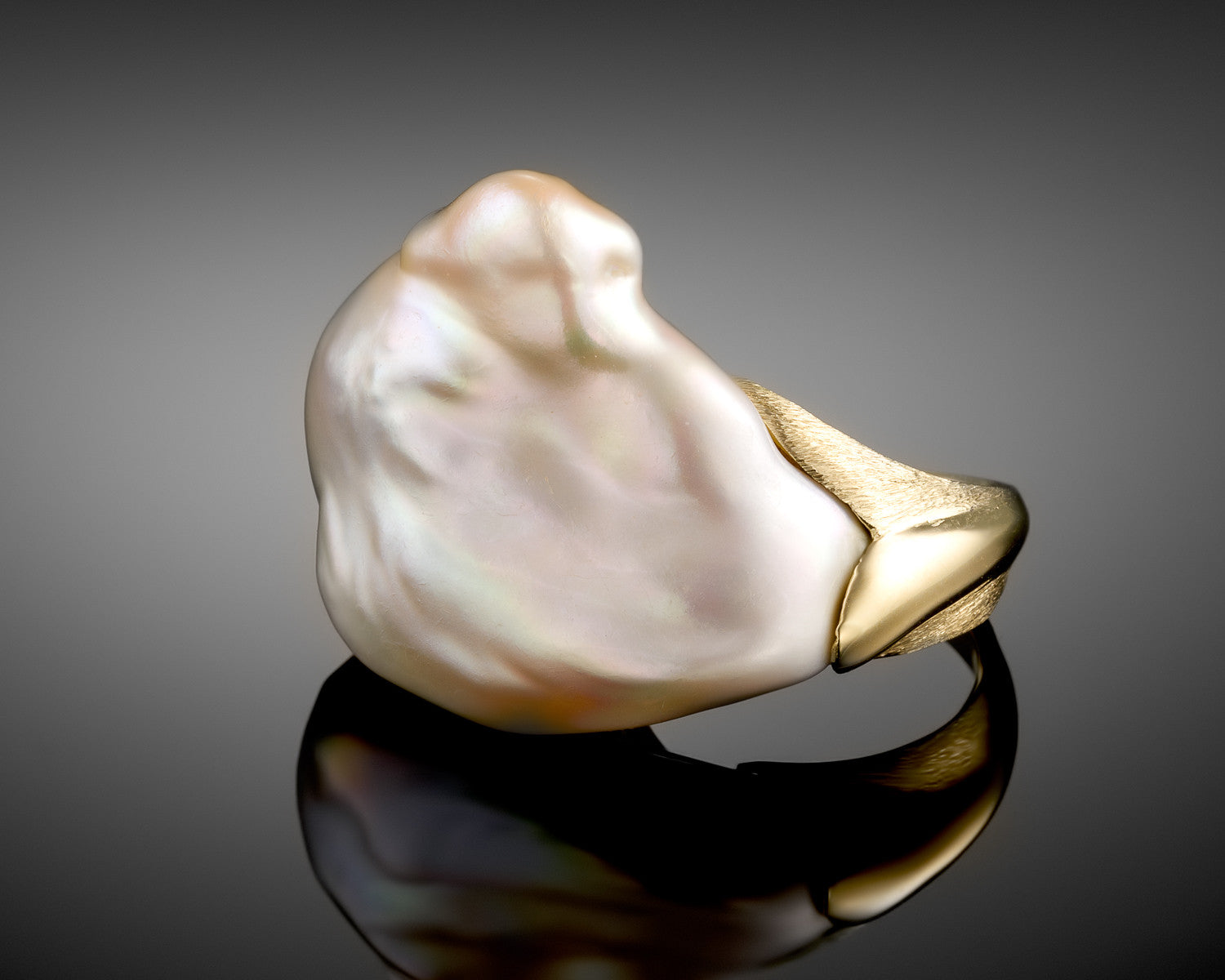
This is where my work starts. A baroque pearl is not a round pearl that went wrong. It is a shape that happened once and will not happen again, so I build the gold around it instead of choosing a pearl to fit a design. Whale, the ring with a pink keshi pearl measuring 27 by 34 mm, began with a pearl whose outline already looked like a whale. Luna holds a baroque keshi in each earring, next to a raw grey diamond.


How to judge a pearl
The Gemological Institute of America names seven factors that set the value of a pearl. I choose each pearl myself rather than buying matched lots, and I judge it on these same seven.
| Factor | What to look for |
|---|---|
| Luster | Sharp, bright reflections. Hold the pearl near a window and look at the edge of the reflection: the crisper it is, the better the lustre. GIA treats this as possibly the most important factor |
| Surface | Few and minor marks. A small mark matters little, especially if a drill hole or the gold hides it. Many or deep marks affect both durability and value |
| Nacre | A visible bead or a dull, chalky look points to thin nacre, which means less lustre and less durability |
| Shape | Round pearls and matching drops are the most valued, but a well-formed baroque, oval or pear shape is prized too. Baroque pearls are judged on lustre and character, not on how close they come to round |
| Color | The bodycolor, plus any overtone (a second hue over the first) and orient (a rainbow shimmer). White and black are traditional, and unusual colours are growing in popularity |
| Size | In general, a larger pearl is worth more. It also changes how a piece sits and wears |
| Matching | For earrings and strands, how closely the pearls agree in the other six factors. Sometimes the mismatch is the point, and a designer mixes sizes or colours on purpose |
If you cannot see a pearl in person, ask for a short video in daylight. A still photo flatters almost any pearl, and a moving one shows the lustre and the surface much more honestly.
What AAA actually means
AAA, AA and A are not a standard. There is no single grading scale for cultured pearls, and each seller defines the letters in their own way, so one seller's AA can be another's AAA. GIA's pearl reports use a separate system and do not translate into those letters.
You will often see a percentage of clean surface attached to each letter. Treat that as one seller's rule, not a fact about pearls. When you compare two pearls, set the letters aside and ask for the written criteria behind them:
- How much of the surface is clean, and what are the marks like
- How the lustre is described, and how thick the nacre is
- What the shape is, and whether the grade says anything about it
- Whether the pearl has been treated in any way
A seller who can answer those four questions plainly is worth more than any letter.
Treatments, imitations and what to ask
A cultured pearl is a real pearl. An imitation is a different thing: usually a glass or plastic bead with a pearly coating. The two get confused, so it helps to know how to tell them apart.
A common home test is to rub the pearl lightly against the biting edge of a front tooth. Real nacre feels slightly gritty, and most imitations feel smooth. It is a hint, not proof, because some imitations now have a coating that feels gritty, and I would not try it on a pearl you are about to buy. Looking at the drill hole is more telling: on a real pearl the edge is clean and the layers are not peeling, while on an imitation you often see paint or a chipped coating over a bead. A jeweler can confirm with a microscope.
Pearls can also be treated. GIA notes that pearls may be dyed, impregnated or coated, and that bleaching and irradiation can be stable through normal wear. Some colours are natural: freshwater pearls grow in lavender, peach, gold and white without any help. Others are made. A pearl that is very bright or very uniform in colour deserves a question.
So ask the seller, in plain words:
- Is this pearl natural or cultured, and where does it come from
- Has it been dyed, bleached, irradiated, coated or otherwise treated
- Is the colour its own
- Can I see it in daylight, on video if I am not there
A good seller answers all four without hesitation.
Wearing and keeping pearls
Pearls are softer than most gemstones, around 2.5 to 4.5 on the Mohs scale, and they are damaged by the things we put on our skin. Most of the care comes down to order and habit.
| Do | Avoid |
|---|---|
| Put pearls on last, after perfume, hairspray, lotion and makeup have dried | Perfume, hairspray, lotion and cosmetics, which can permanently damage the surface |
| Wipe them with a soft cloth after each wear, to remove sweat and residue | Chlorinated pools, hot tubs, and household cleaners |
| Store each piece on its own, in a soft pouch or lined box | Loose in a drawer or touching harder jewelry, which scratches them |
| Keep them at normal room humidity | Very dry storage such as a safe deposit box, and extreme heat, which can dry pearls out and make them crack |
| Take them off before a swim, a workout or a shower | Ultrasonic and steam cleaners, abrasive brushes, and any solvent such as nail polish remover |
Pearls do not breathe, whatever you may have read. What is true is that they hold a little moisture, and they do better in ordinary air than sealed in a dry place.
To clean a pearl, use a soft brush or cloth with lukewarm water and a drop of mild soap, then lay the piece flat on a towel to dry. Do not hang a wet strand, because wet silk stretches. I would not soak a strand, because the thread is the weakest part.
A strand worn often should be restrung about once a year, ideally on silk with a knot between each pearl, so that a break does not scatter the whole thing and the pearls do not rub against each other. For rings and earrings, bring them to me once a year and I will check the setting and the pearl. My general care notes are on the Product Care page.
Pearls in gold
A pearl is a gentle stone to wear in some places and a hard one in others. Earrings and pendants sit away from your hands and from most knocks, which makes them the easiest pearl jewelry for every day. Rings take the most abuse, from hand cream, dishes, door handles and desks. A pearl ring is perfectly wearable, and it is worth choosing one where the gold looks after the pearl.
In Autumn, two gold leaves hold the keshi pearl, so the setting is part of the design and not something added afterward. In Haumea and Moons of Saturn, two freshwater pearls sit at the ends of an open band, and the space between them is the whole idea. Stardust puts a white freshwater pearl against a raw grey diamond, the softest stone beside one of the hardest, which is why it is worth storing each piece on its own.


I work in 18K and 14K gold, and about 90 percent of it is recycled. If you bring me a pearl of your own, I will look at it before promising anything, because the right design depends on the pearl in front of me.
A short history of pearls
The oldest written mention of natural pearls comes from a Chinese historian, dated to 2206 BC. For thousands of years pearls stood for wealth and status. Royal families and wealthy households in Asia and Europe treasured them and passed them down, and when Columbus reached the Americas in 1498 and 1502 he found people there wearing natural pearls. His discovery of pearl beds off what is now Venezuela and Panama sent European demand soaring.
Many cultures tied the pearl to the moon. Europeans linked it with modesty and purity, which is where much of the idea of a pearl as a woman's jewel comes from. The record is more mixed than that. Sir Walter Raleigh wore pearl earrings in both ears, and Charles I wore a single pear-shaped pearl from the age of fifteen until his execution in 1649.
The natural pearl fisheries did not survive overfishing and the arrival of cultured pearls in the 1920s. What replaced them is a pearl that more people can afford, and a wide range of shapes and colours to choose from.
Sources
- GIA, Pearl Buyer's Guide
- GIA, Pearl Description
- GIA, Caring for your jewelry
- GIA 4Cs, History of cultured pearls, part 1
- GIA, Pearl history and lore
- GIA Gems and Gemology, Continuity and Change in Chinese Freshwater Pearl Culture
- GIA Gems and Gemology, Cultured pearls from the Sea of Cortez
- Atlas Obscura, Charles I's pearl earring
